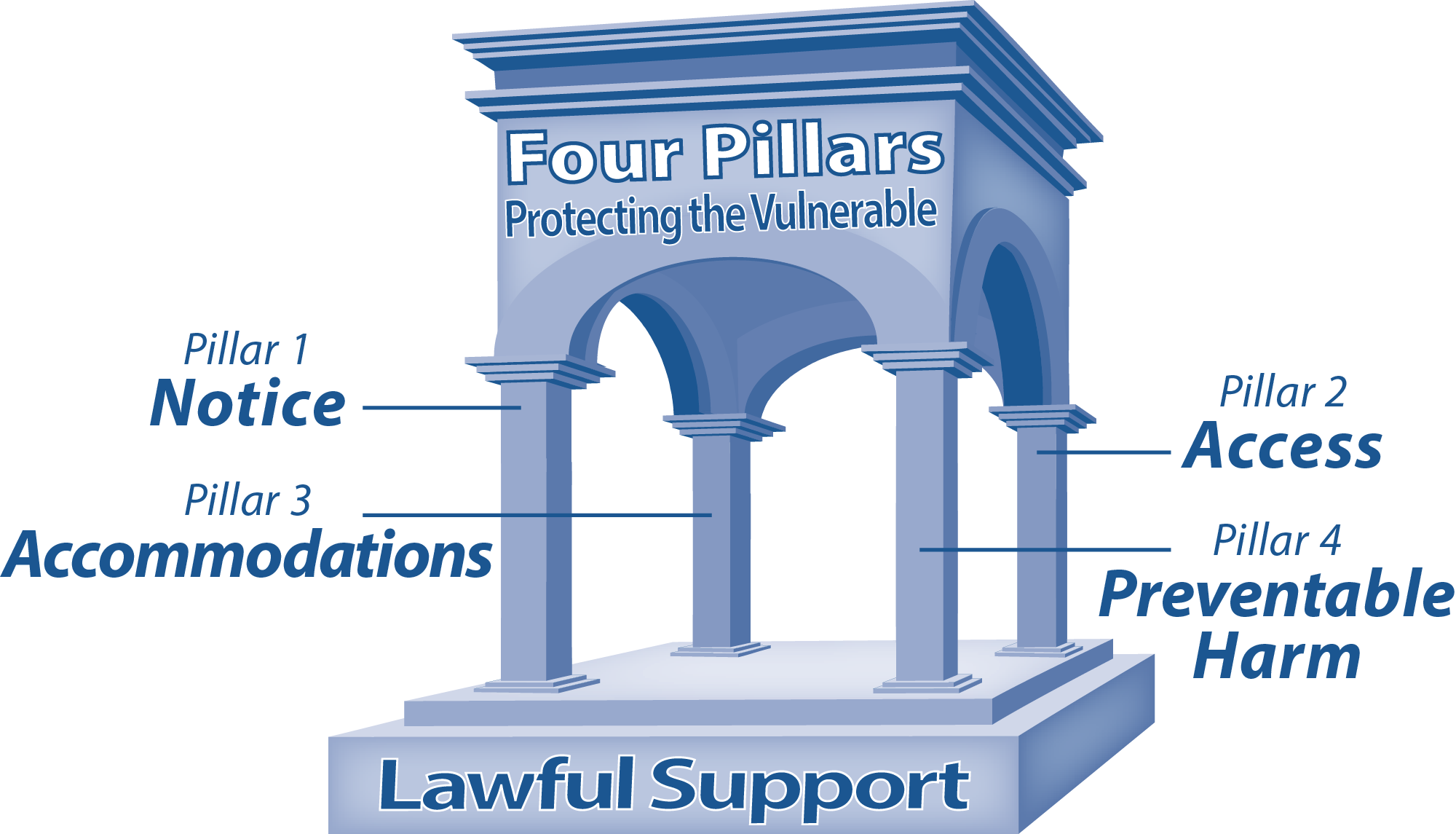
The Four Pillars of Administrative Harm Prevention
The Four Pillars of Harm Prevention are a Reporting Injustice framework developed to organize existing legal requirements into a single causal structure that is easy for people to follow and report. In creating our reports, we realize they follow a predictable pattern of abuse.
Here’s how the “knock out” punch get executed over and over:
Pillar 1 No Notice
Pillar 2 No or Confusing Access
Pillar 3 No accommodations or Abelism
Knock Out - Game Over
Abusive officials are skilled at this and do this over and over with no repercustions.
Citing legal references as we require may be comples, but we realized early on that reports are a failure for each pillar and almost always in combination of the “knock out” seuqence.
is a predictable pattern. Rep•In hopes that it makes the complexity easier to follow.
People abused by the system can now say,
“I was abused under pillar 1 No Notice”
Then abused by Pillar 2 No or Confusing Access, and if that was not enough:
Pillar 3 No accommodations or Abelism indicated I was required to do things beyond my capabilities in less time than a reasonable adult with my limitations could ever do, resulting in
Piller 4, left to suffer, often berated for my limitations, with no recourse, so I had to give up. To fight would be to suffer even worse abuse.
I have been there so many times my head spins. Be wise, as the abuse my not be worth fighting given the next level of abuse coudl be worse. Survival is critical. But this is how the abusers work. They make it so you cannot even report the abuse the create.
If you can find it in you, please help other being abused by the same people and agencies abusing you. We will have a reporting procedure in place soon.
Four Pillars are a powerful and practical framework for identifying, documenting, and stopping harm to disabled people and vulnerable adults inside administrative systems, service agencies, and county personnel.
Most harm done to people with disabilities and vulnerable adults isn’t a simple punch or a shove. The harm follows a 1, 2, 3 - Knock Out sequence almost every time. The pillars make this easy to follow. The 1, 2, 3, - Knock Out sequence is inherent in almost every report of abuse on our site.
Most harm is not physical (the assualt was physical, but the aftermath harm more devastating.
It is procedural. It is systemic. It is inflicted through omissions, delays, misstatements, and structural neglect.
Failure to perform mandated reporting (MAARC has never responded to multiple abuse reports under any circumstances based on facts from multiple reports over many years). I have them documented as lying directly to me (facts) as they fail to investigate abuse after abuse. When the abusers are lying to me and the agency to investigate is also lying to me, it is beyond belief.
Reality: There is noone who will hold anyone who abuses me accountable. The judge dismissed my case saying I said something the recording clearly says I did not say, and also proves he never said what he later claims he said.
It is an an uneasy reality to accept, but after so many thefts, taunting remarks, destruction of property, and the list seems endless, I realize people like me are rarely protected by the institutions authroized to protect us.
Letters that never arrive
Deadlines no one can meet
“Options” no one can understand
Information mixed up and with ‘small’ mistakes creating confusion
Systems that ignore disability by assuming the person can do what they can do “ableism”
The Four Pillars give individuals, families, advocates, and investigators a way to:
Spotting and naming what went wrong clearly
Tie failures to laws, statutes and obligations
Demonstrate harm (Statement of Harm)
Demand corrective actions
The Pillars apply to case management, applications for help, appeals, investigations, and any system where decisions about services, housing, safety, or benefits are made.
A framework for documenting statutory failure and preventable harm.
Most harm done to people with disabilities and vulnerable adults is not dramatic or physical.
It is ableism carried out through procedure — paperwork, deadlines, silence, and missing steps.
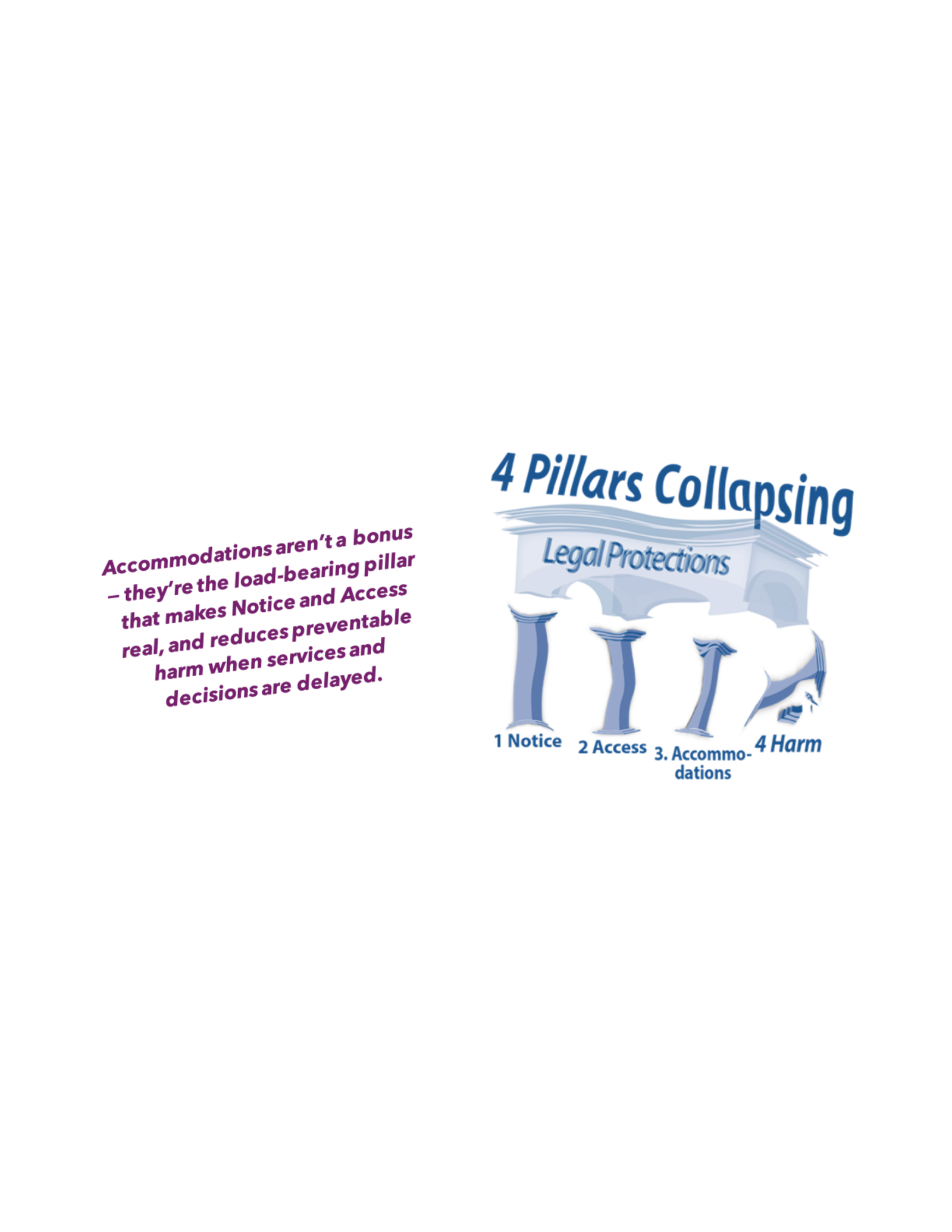
A system and the people acting within it fail to give Notice, then deny Access, then withhold Accommodations — and the sequence repeats until the roof comes down on the person underneath.
Afterward, they claim it was confusion, a mistake, or “just how the process works.”
The Four Pillars exist to stop this serial pattern by making each duty failure visible, documentable, and enforceable before more preventable harm occurs.
Otherwise, they just repeat the same serial story as a broken record: “we’ll follow up,” “we forgot,” “nothing was required,” until the harm is done.
The Four Pillars provide a legal and administrative framework for documenting unlawful breaches of required duties, explaining how those unlawful actions deny Notice, Access, and Accommodations, and proving the Preventable Harm that follows for real people living with disabilities who are also often vulnerable adults.
A single breach may be negligence.
A repeated pattern is systemic — produced and maintained by the system and the people acting within it.
Repeated patterns communicate deliberate indifference — an intentional disregard for required duties.
The message is often one of underlying hostility and passive-aggressive retaliation through nonresponse, delay, undisclosed changes to records, “forgotten” steps, or shifting explanations that deny legally mandated Notice, Access, and Accommodations.
When these systemic breaches repeat over and over, they form an administrative pattern of abuse against real people living with disabilities and vulnerable adults.
These are not technical errors. For people already close to the edge, sequential pillar failure can mean losing safety, housing, medical stability, legal rights, or life itself.
The Four Pillars are legally grounded in ADA Title II, Section 504, the Minnesota Human Rights Act, the Minnesota Government Data Practices Act, fair-hearing law, and the Minnesota Vulnerable Adults Act.
Most instances of harm affecting people with disabilities and vulnerable adults follow a predictable sequence of pillar failure. When Notice, Access, and Accommodations collapse, the roof comes down on the person underneath. The Four Pillars make that pattern visible and legally documentable, one pillar at a time.
This structure helps reporters and advocates for people with disabilities avoid being overwhelmed by complexity, because the form mirrors the same four-step duty chain every time.
Reporting Injustice’s report submission form is built on the Four Pillars to ensure consistent reporting, clearer legal alignment, and stronger evidence trails across cases. Each report submitted is already structured for investigation and legal use.